A Simple Guide to Copywriting for Websites in 2026
Your website is your digital marketing storefront – most times potential customers come to your website before reaching out to work with you. Whether or not they feel confident enough to inquire about your services is up to the actual words on the page.
If you aren’t getting inquiries from your website or getting inquiries from the wrong people, it might be a sign that your website copy needs updating.
I’m Stacy Braga and I’m a copywriter who has worked with dozens of clients on their website copy. Maybe you wrote the current version years ago and a lot of things have been changed in your business. Maybe you serve a different type of client now. Either way, it’s time to update your website copywriting so the right fit clients reach out and inquire.
What’s the first step to copywriting for your website?
Before you open up a blank document and start writing, there’s some prep work that you need to do. First, getting clear on exactly who you want to work with. This is a great time to talk to some of your ideal customers (either past clients or potential clients) and learn more about their experience.
The most important thing your website should do is not just showcase you as the expert, but also showcase why you’re the right person for this particular client. This means being clear on exactly what problem you solve for them and how you solve it. Use this information to create a messaging guide to inform your website copy.
What goes in a website copywriting messaging guide?
Your messaging guide is all about the story your website is telling. There are five core pieces your messaging guide should include:
Problem: What is your ideal client currently experiencing? How does it show up for them? You don’t need to harp on this or rub salt in the wound, but an acknowledgement of their current reality goes a long way.
Assessment: Why is the problem actually showing up? Usually what clients experience as the problem is actually a symptom of something deeper. As the expert, can you show them what the actual problem is? This is where you can showcase your authority and reframe things for your reader.
Solution: If the problem is where they are now, the solution is where they want to be. Here’s where you show them you understand exactly where they want to go. This is also a great place to showcase case studies and client testimonials. When your potential clients see other people who have gotten the same transformation they want, it builds credibility and trust in your brand.
Product: This is where you show how your service or product gets them from point A to point Z. What are the steps your service provides, and how does each step move them to where they want to go? Why do you include each part of your service, and how does it help?
You: This is about differentiating yourself from your competitors. Why are you the right choice? How do you do things differently than others? What experiences and lessons have you learned that change the way you approach your work?
What else to consider about website copywriting?
Another thing to consider about website copywriting is your brand voice and tone. Before you start writing, it’s helpful to think about how you want your ideal client to feel when they land on your website. A website that gets someone fired up and excited will sound different than a website that is more empathetic and caring.
Knowing how you want someone to feel as they land on your website can help you tailor the words and sentence structure you use to speak directly to your ideal client.
How do I write website copy once I have my messaging down?
Once you have your messaging down, I recommend starting with the easiest pieces first and finishing with the hardest pages. Often your homepage will be the hardest because it has to capture attention and clearly state what you do and who you help in the most clear and concise way. This means it might take longer to find those words.
Starting with the information you already know, such as your offers, what they include, the pricing, and then moving towards the bigger picture of how you help people gives you time to warm up your writing muscles and get something on the page.
What order should I write my website copy in?
The order will depend on you but usually service and sales pages are good starting points. I’d recommend doing a gentle outline of the entire website (refer back to your messaging guide!). Then start at the bottom of the page with offer details, the call to action, and frequently asked questions. These are usually straightforward and easier to plug and play.
From there, start filling in the tops of pages and think about what might capture your audience’s attention. It’s useful to write multiple versions of headlines (sometimes I write 30+ before deciding on one!) Understand that your first draft might need some work, and give yourself time between drafts to marinate and come up with new ways to say things.
What should I consider for each website page?
Most websites have three main sections: home page, about page, and services pages. As you’re writing each of these pages, keep the following in mind:
Home page: This page is your storefront. The job of this page is to get people to keep reading and click onto your service pages to learn more. You want it to be super clear from the second people land on your page exactly what you do and who you help.
About page: This page is about you, but it’s really about your customer. This is where you showcase your approach and why you do things in the way that you do. Yes, talk about your credentials and experiences but make sure to connect it back to how they actually help your clients solve their problems.
Services page: The main goal of a service page is to get people to take action. That action depends on your goal – it could be to book a call, fill out an inquiry form, or simply join a waitlist. The main mistake I see on service pages is focusing too much on the deliverables and not enough on the benefits of this offer and how they directly help your ideal clients. Be clear on what the big promise of the offer is and make sure it’s clear and concise.
What about editing the copywriting on your website?
When looking at editing your website copy you want to look for three things:
The first thing is transitions. Are the transitions between sections smooth, and is there a common thread that goes from the top of the page through the bottom of the page? If someone reads the whole page, does it actually make sense? If someone just reads the headlines, does it still make sense?
Next, you want to think about readability. Are you using the words your ideal clients would use to describe their problems, or are you writing as an expert who is talking to other experts? Are you using clear and concise language, or is your writing very dense (it’s a website, not a textbook!)
Finally, think about your messaging guide that you started with. Does your website tell the story that’s represented in your messaging guide? Does this story reflect your ideal customer?
Final note on copywriting for your website
Writing for your website can be difficult because you’re so close to what you do, and it can be hard to put that into words. As an expert, you can get bogged down in the details that it becomes difficult to make decisions about what you’re saying and how you’re saying it.
At the end of the day, your website should tell a core story about a specific person. Once it does that, when people arrive on your website, they will feel confident that you understand exactly what they’re going through, where they want to go, and how to get them there. This feeling of acknowledgement and moving them towards a goal is what drives action.
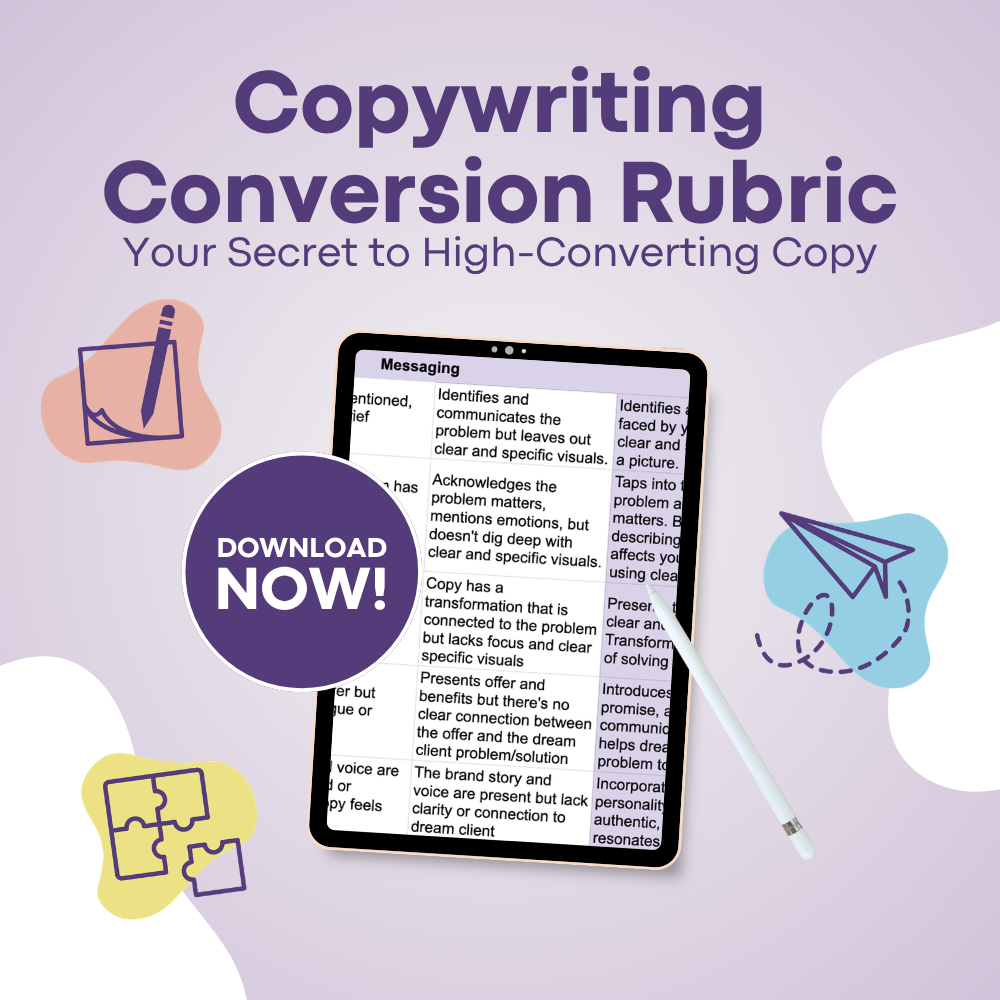
Get the copywriting rubric to help you write a website that gets more inquiries
Get your free Copywriting Rubric to help you write a website that brings in inquiries from the right fit clients. It’s the exact rubric I use when writing copy with Studio clients and reviewing copy inside the Copy Classroom.